Why Surface Preparation is the Most Critical Step in Industrial Finishing
In every industrial process—whether it is automotive manufacturing, aerospace engineering, marine maintenance, or metal fabrication—surface preparation is the foundation that decides the final quality of the product. No matter how advanced the coating, paint, or polishing material is, it will only perform well if the base surface is properly cleaned and prepared.
This is where modern technology like the wet sand blasting machine plays a crucial role. It is an advanced surface treatment system designed to clean, polish, and finish components using a controlled mixture of water, abrasive media, and compressed air. Because of its precision and controlled operation, this system is also widely referred to as a wet blasting machine, wet blasting equipment, or wet abrasive blasting equipment in industrial applications.
Compared to traditional dry blasting methods, a wet sand blaster offers a much safer and more refined cleaning process. It significantly reduces airborne dust, minimizes surface damage, and delivers a smoother, more uniform finish. This makes it highly suitable for industries where accuracy, surface integrity, and operator safety are equally important.
In specialized applications where extremely delicate cleaning is required, technologies such as wet soda blasting equipment are also used. These systems provide even gentler surface treatment, making them ideal for sensitive metals and precision components.
What is a Wet Sand Blasting Machine?
A wet sand blasting machine is a surface treatment system that uses a slurry mixture of:
- Water
- Abrasive media (such as glass beads, aluminum oxide, or garnet)
- Compressed air
This mixture is sprayed at high pressure onto a surface to remove rust, paint, oil, and other contaminants while also polishing and smoothing the material.
This type of wet abrasive blasting equipment is commonly used where precision cleaning and high-quality surface finishing are required. Compared to dry blasting, a wet blasting machine provides a more controlled and surface-friendly cleaning process.
Working Principle of Wet Sand Blasting Machine
The working of a wet sand blasting machine is based on controlled slurry blasting technology used in modern wet blasting equipment systems.
First, water and abrasive media are mixed in a tank to form a slurry. This slurry is then pressurized using an air compressor system. The pressurized mixture is directed through a specially designed nozzle at high speed.
When the slurry impacts the surface, it removes unwanted layers such as rust, paint, and oxidation. The water in the system acts as a cushioning agent, reducing surface damage and producing a smooth finish.
Advanced wet abrasive blasting equipment includes filtration and recycling systems that allow reuse of slurry, reducing operational cost and waste.
Key Components of Wet Sand Blasting Machine
A typical wet blasting machine or wet sand blaster consists of the following parts:
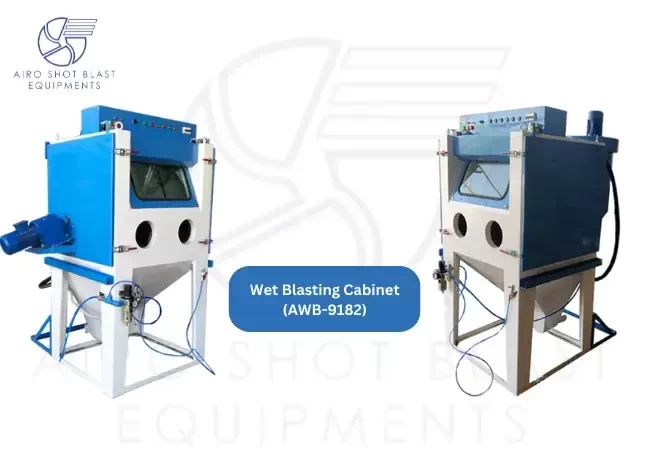
- Blast cabinet or enclosed chamber
- Slurry mixing tank
- Air compressor system
- High-pressure nozzle
- Pump and circulation system
- Filtration unit
- Control panel
Each component of wet blasting equipment plays a crucial role in ensuring smooth, efficient, and safe operation.
Wet Sand Blasting vs Dry Sand Blasting
Wet sand blasting and dry sand blasting are both surface cleaning methods, but they differ significantly in performance and application.
A wet blasting machine uses water along with abrasive media, which reduces dust, heat, and surface damage. It provides a smoother and more refined finish, making it ideal for precision industries.
Dry sand blasting uses only abrasive particles, which makes it more aggressive but also creates dust, heat, and a rough surface finish.
In modern industries, wet sand blaster systems are preferred when safety, precision, and surface quality are more important than speed.
Advantages of Wet Sand Blasting Machine
A wet sand blasting machine or wet abrasive blasting equipment offers several important benefits:
It produces almost no dust, making it safer for workers and environmentally friendly. The water in the system reduces friction and heat, preventing damage to delicate components.
It also provides a smoother and more polished surface finish compared to dry blasting. This makes wet blasting equipment ideal for precision engineering applications.
Another major advantage is reduced abrasive consumption, which improves cost efficiency and performance over time.
Some specialized applications also use wet soda blasting equipment, which is even gentler and suitable for sensitive surfaces like aluminum or thin metals.
Disadvantages of Wet Sand Blasting Machine
Despite its advantages, a wet sand blasting machine also has some limitations.
The initial cost of wet blasting equipment is higher compared to dry blasting systems. It also requires proper water handling and filtration systems.
If parts are not dried properly after blasting, there is a risk of flash rusting. Additionally, maintenance is slightly more complex due to pumps, seals, and water circulation systems.
Applications of Wet Sand Blasting Machine
Wet sand blasting machines are used in a wide range of industries:
In the automotive industry, a wet sand blaster is used for cleaning engine parts, carburetors, and gear components.
In aerospace, wet abrasive blasting equipment is used for turbine blade cleaning and precision component finishing.
In marine applications, it helps remove rust and salt deposits from ship parts and propellers.
Manufacturing industries use wet blasting machines for mold cleaning, deburring, and surface preparation before coating or painting.
Restoration industries also rely on wet blasting equipment for cleaning old machinery and vintage components.
Types of Wet Sand Blasting Machines
Different types of wet blasting equipment are available depending on application:
Cabinet type machines are used for small and medium parts in controlled environments.
Portable machines are used for on-site cleaning of large structures.
Automated systems are used in industries for mass production with consistent results.
Pressure-based systems are used for heavy-duty cleaning, while suction-based systems offer more controlled operation.
Buying Guide for Wet Sand Blasting Machine
Before purchasing a wet sand blasting machine, several factors should be considered.
The purpose of use is important, whether it is heavy cleaning or fine finishing. Machine size and capacity should match production needs.
Pressure rating directly affects cleaning speed and finish quality. Compatibility with different abrasive media is also important.
Build quality, filtration system, and maintenance requirements should be carefully evaluated before investing in any wet blasting equipment or wet sand blaster system.
Maintenance of Wet Sand Blasting Machine
Proper maintenance ensures long machine life and better performance of wet abrasive blasting equipment.
Daily cleaning of the nozzle and checking pressure levels is recommended. Weekly inspection of hoses and filters helps avoid blockage.
Monthly maintenance should include deep cleaning of the tank, checking pump systems, and replacing worn-out parts if needed.
Common Problems and Solutions
Low pressure in a wet blasting machine is usually caused by air leakage or compressor issues. Uneven finishing occurs due to incorrect slurry mixture.
Nozzle wear is normal due to continuous abrasive impact and should be replaced regularly. Blockage in the system can be avoided by proper filtration of abrasive media.
Future of Wet Sand Blasting Technology
Wet blasting technology is continuously evolving. Modern wet blasting machines are becoming more automated and energy efficient.
Future systems will include AI-based pressure control, improved recycling systems, and eco-friendly designs that reduce water and energy consumption.
Advanced wet abrasive blasting equipment will play a key role in Industry 4.0 manufacturing systems.
Conclusion
The wet sand blasting machine, also known as a wet blasting machine or wet sand blaster, is an advanced industrial solution for surface cleaning and finishing.
It provides superior results compared to traditional dry blasting methods by offering better safety, smoother finish, and environmental benefits.
With increasing demand in automotive, aerospace, marine, and manufacturing industries, wet blasting equipment and wet soda blasting equipment are becoming essential tools for modern surface preparation needs.
Advanced Wet Blasting Solutions for Industrial Surface Finishing
Modern industries require highly efficient and precise surface preparation systems to achieve superior coating, painting, and finishing results. Advanced technologies like wet blasting machines, wet sand blasting machines, and wet blasting equipment have become essential for achieving dust-free, smooth, and high-quality surface cleaning across multiple industrial sectors.
These systems use a controlled combination of water, abrasive media, and compressed air to remove rust, paint, oil, and other contaminants without damaging the base material. Compared to traditional dry blasting methods, wet sand blasters and wet abrasive blasting equipment offer better surface finish, improved safety, and reduced environmental impact.
A complete range of surface finishing solutions is available, including high-performance wet blasting machines, precision-based wet soda blasting equipment, and industrial-grade wet abrasive blasting systems designed for different applications such as automotive parts, aerospace components, marine equipment, and heavy fabrication work.